
The Stellar Angel K2 System: Kizuna, Kakugo and No Choice
How the K2 choice system works in The Stellar Angel: kizuna and kakugo poles, the unlabelled third option, and how the meter decides your ending.
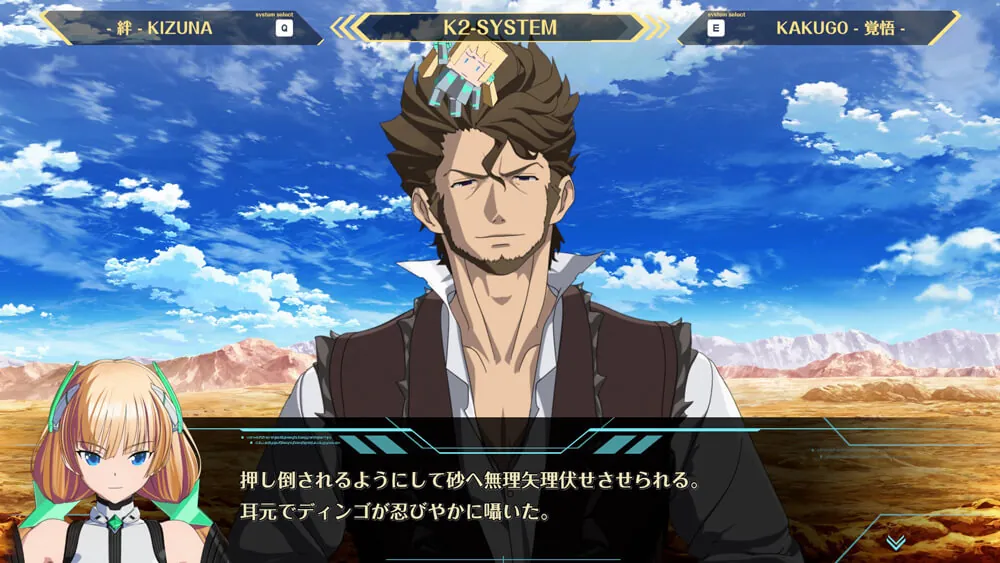
K2 is The Stellar Angel's choice system. Each prompt asks whether Angela follows her feelings as a person (KIZUNA, bond) or her resolve to finish the mission (KAKUGO). A third, unlabelled option refuses both. The meter it moves decides Terra, Signal Fire or Loss.
- KIZUNA leans Angela toward the people around her.
- KAKUGO leans her toward the mission and the bureau.
- The third option moves neither pole, which is how a run ends in the 0 END.
The system is explained on the official site in two sentences, and those two sentences are the whole key to the game. The choices guide → covers when the prompts appear; this page covers what they do.
What does K2 stand for?
The game presents K2 as a decision interface rather than a stat screen. The two poles are written in Japanese as kizuna and kakugo, rendered in English as bond and resolve. The official explanation frames them as two pulls on Angela: her emotions as a human being, and her determination to carry out her duty.
That framing is unusually literal for a visual novel. You are not choosing an opinion; you are choosing which part of Angela's identity gets stronger.
How does the meter work?
Each K2 prompt shows a gauge with both directions. Confirming a choice moves the needle toward one pole; the third option leaves it roughly where it was. The gauge persists across scenes, so early decisions constrain late ones.
There is no visible number, which is deliberate. You are meant to read the needle as Angela's state of mind, not as a score to optimise. The problem is that the finale does check it, so players who ignore the needle can arrive at an ending they did not want.
Which endings does the meter control?
Two directly: Terra for the bond pole, Signal Fire for the resolve pole. Loss is the null case where the meter never resolved. The true ending, Seeds of Paradise, sits outside the meter and needs its own condition.
That gives the meter a clear job. It is not the whole ending system; it is the part that decides which of the two positive conclusions you are eligible for.
What is the third option?
It is a visible third choice that is neither bond nor resolve. The official K2 explanation does not mention it, and the game does not label it, but the interface shows it and confirming it produces a different response.
Mechanically it is a refusal: Angela declines the frame the prompt offers. Narratively that is interesting, and it is the fastest way to hear alternate dialogue. Strategically it is a trap for completionists, because a run built on refusals accumulates nothing.
Should you ever pick the third option?
Yes, in three situations: when you want to hear a scene's alternate read, when both poles would push you toward an ending you do not want, and when you are deliberately farming the 0 END.
Outside those cases, pick a pole. The game is short enough that a committed run is more rewarding than a sampling run, and the endings are written as conclusions rather than as branches to browse.
How do you keep a run on one pole?
Three rules cover most of it:
- Decide your target ending before the route commits.
- At every K2 prompt, ask which pole the scene is offering and pick the one that matches your target.
- Never use the third option twice in a row unless you want Loss.
The Angela route guide → and Dingo route guide → note where each route makes the opposite pole tempting, which is usually where runs drift.
Is K2 a morality system?
No. Bond is not good and resolve is not bad; both produce finished, sympathetic endings. The bad endings come from breaking a direction or from following a character thread too far, not from choosing the "evil" option.
That is worth remembering when the KAKUGO choice looks cold. On Angela's Route it often is the professionally correct answer, and the game respects it enough to give it a full ending.
Common mistakes
- Treating the meter as flavour. It gates two of the seven endings.
- Splitting choices to "see more content". That is the recipe for Loss.
- Assuming the third option is the secret true path. It is a refusal, not a key.
- Changing target mid-route. The meter has memory and the finale reads the total.
FAQ
What do KIZUNA and KAKUGO mean?
Bond and resolve. KIZUNA leans Angela toward the people around her; KAKUGO leans her toward her mission.
Does K2 decide the true ending?
No. Terra and Signal Fire are meter checks; Seeds of Paradise is a separate condition.
Is there a way to see the meter numerically?
No. The gauge is visual only, which is why route guides describe behaviour rather than scores.
What happens if you always pick the third option?
The meter never resolves, and the run lands on Loss, the 0 END.
Sources
Official source: The Stellar Angel official site ↗ — K2 system explanation and branch warning.
- Steam achievements for App 4607420 ↗ — Bond, Resolve and 0 END flags.
Official source: Steam store page ↗ — release and premise. Official source: Nintendo product page ↗ — platform details.